What Your Legacy Tech Stack Is Actually Costing You — And Why Rivals Are Pulling Ahead
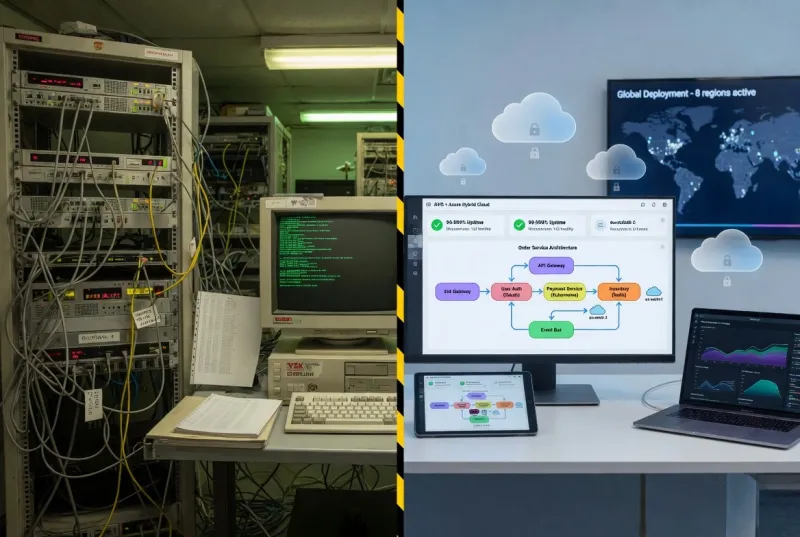
Photo: outdated server room versus modern cloud infrastructure business technology, via tizbi.com
There is a particular kind of organizational pain that never shows up as a line item on a budget report. It does not trigger an incident alert or generate a help desk ticket. It simply accumulates — quietly, persistently — until the morning a competitor ships a feature in two weeks that your team estimated would take six months. That is the moment legacy infrastructure announces itself.
For many mid-size and enterprise businesses across the United States, that moment is arriving faster than expected. The question is no longer whether modernization is necessary. It is whether leadership fully understands what inaction is already costing them.
The Invisible Tax on Business Agility
Legacy systems impose what analysts increasingly refer to as an "agility tax" — a compounding drag on the organization's ability to respond to market shifts, customer demands, and competitive pressure. Unlike a capital expenditure, this tax does not appear on a balance sheet. But its effects are measurable.
A 2023 report from McKinsey & Company found that organizations running on outdated technology stacks spent, on average, 70 to 80 percent of their IT budgets simply maintaining existing systems — leaving less than a quarter of resources available for innovation. Meanwhile, companies that had completed meaningful modernization programs redirected that ratio almost entirely. The result was a deployment frequency three to four times higher, and a time-to-market advantage that compounded year over year.
Consider the operational reality inside a company still running on a monolithic ERP system built in the early 2000s. Every new integration requires custom middleware. Every regulatory update demands weeks of manual patching. Every analyst who needs cross-departmental data submits a request and waits. None of these friction points look catastrophic in isolation. Together, they represent thousands of hours of lost productivity annually — and an organizational culture that has quietly learned to lower its ambitions.
Security Vulnerabilities That Don't Make Headlines — Until They Do
Beyond the productivity drain, legacy infrastructure introduces a security exposure that is both significant and chronically underappreciated. Software vendors routinely sunset support for older platforms, which means that vulnerabilities discovered after end-of-life dates receive no official patches. Organizations running these systems are left to either build their own security fixes or absorb the risk.
The Ponemon Institute has documented average data breach costs in the US exceeding $9.4 million — the highest of any country globally. A disproportionate share of those breaches trace back to unpatched legacy components. For business leaders who have delayed modernization on cost grounds, this is the counterargument that tends to land hardest: the cost of a single significant breach can dwarf a multi-year modernization budget.
Beyond direct breach costs, there is the compounding effect of compliance risk. Regulations such as CCPA, HIPAA, and evolving FTC guidance on data practices are increasingly difficult to meet with infrastructure that was never designed to accommodate them. Legal and compliance teams are often the first to raise the alarm — not because they understand the technology, but because they understand liability.
The Competitive Gap Is Not Linear — It Is Exponential
Perhaps the most underappreciated dimension of legacy infrastructure cost is competitive divergence. When a digitally mature competitor ships updates weekly and your team ships quarterly, the gap between your capabilities does not grow arithmetically. It accelerates.
Modern cloud-native architectures, microservices design, and continuous integration pipelines allow organizations to test, learn, and iterate at a pace that was simply not possible a decade ago. Companies that have made these investments are not just faster — they are building institutional knowledge and engineering culture that becomes increasingly difficult to replicate over time.
Retailers who modernized their fulfillment and inventory systems before the pandemic were able to pivot to omnichannel models in weeks. Those still operating on legacy warehouse management systems struggled for months. The divergence was not purely technological — it was strategic. The companies with modern infrastructure had optionality. The others did not.
A Practical ROI Framework for Modernization Decisions
For leaders who recognize the problem but face internal pressure to justify modernization investment, the following framework provides a structured starting point.
Step 1: Quantify the maintenance burden. Calculate the percentage of your current IT budget allocated to maintaining versus building. If maintenance exceeds 60 percent, you are already operating at a structural disadvantage.
Step 2: Measure deployment frequency and lead time. How long does it take from a committed feature to production deployment? Industry benchmarks from the DORA (DevOps Research and Assessment) report classify high-performing organizations as deploying on demand, multiple times per day. If your answer is measured in weeks or months, that gap has a dollar value.
Step 3: Assess integration debt. Count the number of point-to-point integrations in your current architecture. Each one represents a fragility point and a maintenance obligation. Organizations with high integration debt pay a compounding cost every time a connected system updates.
Step 4: Model the cost of delay. For every quarter modernization is deferred, calculate the lost deployment cycles and the market opportunities that require capabilities you do not yet have. This is speculative, but directionally powerful — and it reframes modernization from an expense to a revenue protection strategy.
Step 5: Benchmark against peers. The US technology sector publishes enough comparative data that most industries can identify where they fall on the digital maturity curve. If your competitors are deploying cloud-native architectures and you are not, that benchmark should inform your urgency calculus.
Moving Forward Without Starting Over
One of the most persistent myths about legacy modernization is that it requires a complete system replacement — a "big bang" transformation that disrupts operations and consumes years of capital. In practice, the most successful modernization programs in the US have followed an incremental, domain-by-domain approach.
The strangler fig pattern, popularized in enterprise architecture circles, involves gradually replacing legacy components with modern equivalents while keeping the system operational. It is slower than a full replacement, but far less risky — and it allows organizations to begin capturing value from modernized components before the migration is complete.
The goal is not perfection. It is momentum. Organizations that begin modernizing — even incrementally — start rebuilding the institutional capacity for speed and experimentation that legacy infrastructure has suppressed.
The Strategic Imperative
Digital transformation is not a technology decision. It is a competitive strategy. The companies that treat legacy modernization as a cost center to be minimized are, in effect, choosing to cede ground to rivals who treat it as a growth investment.
The data is consistent: organizations that modernize move faster, spend less on maintenance, suffer fewer security incidents, and respond more effectively to market change. Those that defer the decision do not avoid the cost — they simply pay it differently, in slower growth, lost talent, and missed opportunities.
For US business leaders evaluating where to focus strategic investment in the coming fiscal year, the legacy infrastructure question deserves a place at the table — not as an IT agenda item, but as a board-level conversation about competitive positioning.